DREW TURNS 50!!

So Andrew Nowicki is my oldest and best friend – I’ve known him since the seventh grade, almost forty years now – and today he turns 50. To celebrate this momentous event, I thought I’d tell the story of how we became fast friends. 

Drew was in my algebra I class in the seventh grade at Martin Luther King, Jr Magnet High School in Nashville, 1986-87. I had to dust off the old yearbooks to check the dates on that, which is always a hoot. My earliest memories of Drew are a tall, lanky blond who never looked stressed, and who always wore a (if memory serves) beige Members Only jacket with the sleeves pushed up. It could have been grey. Drew always sat in the back, never really drew (ha!) attention to himself, and it wasn’t until the beginning of the second semester that I even really got to know him. I don’t even remember the context that well, but we went on a field trip somewhere that had a giant mall, and I ended up hanging out with him and Lee Winters while we roamed the mall. We ended up at the arcade, blowing through quarters on a game like Gauntlet or some shit, laughing our balls off and having a great time. 

Soon after that, Drew and I became inseparable. This was in the days when kids slept over at each other’s houses, a cultural phenomenon I mourn the death of, because it was the course of a lot of my fondest childhood memories (in the South this was known as “spenninnanight” – say it out loud with a drawl and you’ll get it). Drew and I spent many a weekend at each other’s houses, staying up all night playing video games – well, I would pass out and he’d power through, determined to beat the thing before we had to take it back to Blockbuster or Hollywood Video. Great times. 

But the moment that sealed the deal was another field trip, this time a bus ride to Oak Ridge, Tennessee, to visit the nuclear power plant. (We were going to a science and engineering magnet, so this made some sense, at least.) Oak Ridge was a solid four hour drive away, so we piled onto the chartered bus and settled in for the ride. By this point, Drew and I had spent enough time together at lunch, recess, and in gym class talking about all the things tweens talked about in the late Eighties, mainly movies and music. I would go on to learn that Drew was, by nature, a collector, and music was and still is his main obsession. He’s the guy who has to have every album of a band, regardless of whether it’s his favorite or not. His cassette collection, even then, boggled my mind, and despite its already prodigious size, once CDs came out, he wasted no time in replacing every single tape with the CD version of the same album. That’s just who he is. 

These days, he collects mainly concerts, from what I’ve seen. He pounces on LiveNation’s $25 Ticket Weeks every year and goes to as many shows as he possibly can. Not having kids, he has more free time than I and can handle late weeknights out better than I can. But several times a month, he’s at a show somewhere.

So we had discussed music before we left for the trip. These were the glory days of the Walkman, and while we knew we could entertain ourselves alone with our respective headgear, we had zero intention of doing so. Music was meant to be shared, man, so we were gonna share it. But how?

Drew had the answer. I brought my iconic 80s boombox, some silver plastic behemoth made by whatever Japanese company was cranking ‘em out at the time, probably Aiwa or some shit, and Drew brought the magic bullet: his spliiter headphone jack. You remember this miracle of technology, right? A little plastic widget that plugged into the single 10mm headphone jack on your boombox/Walkman/whatever, and the other end had TWO jacks, so the signal would split and go into TWO sets of headphones. Ingenious. Whoever came up with that deserved the goddamn Nobel Prize. Corporate America being what it is, he probably got fired instead while some smarmy C-suiter took the credit. We think this shit is all new these days, don’t we? But I digress. 

Anyway, Drew had one of the magical devices, and we plugged it right into the port on my box, and he slammed his cassette of AC/DC’s Who Made Who into the slot, and off we went to glow in the dark.

For those of you who somehow have lost your memories of growing up in the 80s, AC/DC was an Australian rock band that gained iconic international status after the death of their original lead singer, Bon Scott, who choked to death (as so many seemed to around 1980) on his own vomit while passed out from drinking. Rather than calling it quits, the rest of the band hired a new lead singer, Brian Johnson, and proceeded to put out one of the best hard rock albums of all time, Back in Black. You know it, you know the tunes, they’re still popular today – Tony Stark’s theme music in Every. Single. Marvel movie is AC/DC, the first of which is “Shoot to Thrill”, a classic banger that happens to be Track #2 on BiB. AC/DC were superstars after the album came out, so much so that they were recruited to provide the soundtrack for another iconic film from the 80s, Stephen King’s Maximum Overdrive

If you don’t remember that one, don’t feel bad – King barely does, either. It was his dorectorial debut, he was stoned out of his gourd while making it, and it’s a legitimate turd. After a slew of ultra-successful adaptations of his books, King was offered the chance to direct a film of his own, and so he adapted his short story “Trucks” into a mediocre horror movie starring Emilio Estevez. Machines came to life and started killing everyone, and a ragtag group of people stranded at a truck stop had to fight for their lives to escape the horde of demonic semis that threatened them, the leader of which was a giant black 18-wheeler with the grinning mug of the Green Goblin mounted on its grill. This was the period in his life when coke was a bigger priority for King than the quality of his work, and so the movie bombed at the box office, but, like every piece of film ever made before streaming, it found a cult following on home video and cable for years. 

As bad as the movie is, I loved it as a ten year old, and one of the reasons was because of the soundtrack – nothing but banger after banger of AC/DC rock songs, including an original track for the movie entitled “Who Made Who” which kicks off the album, followed by the biggest hit of their career, “You Shook Me All Night Long”. This is, of course, the single from BiB that made them worldwide famous, so it was in the movie –  it closes out the final shot as our band of heroes escapes on a sailboat to a deserted island off the coast to await the inevitable day when the machines would run out of gas. The movie was cheaply made, poorly written, and it was an absolute hoot. And the soundtrack rocked. 

So as we sat on the not-so-sentient-or-malevolent charter bus, ready to bathe ourselves in nuclear radiation, and Drew pops the cassette in. We plug our headphones into his miracle splitter jack, and off we go with AC/DC propelling us down the highway. But here’s the kicker: we only listened to the first two tracks. As soon as the last overdriven chords of “You Shook Me” rang out, we would instantly rewind the tape to the beginning and start over again with “Who Made Who”. This was waaaaay before putting anything on repeat with the tap of a finger was even a possibility – we had to do it the old-fashioned way, by… well, by pushing the Stop button, then the Rewind button, and then the Play button. So THREE taps of a finger, sure. But we did have to WAIT for several seconds for the magnetic tape to spool itself back to full size again, so there you go. Uphill both ways, in the snow, you young’uns don’t know what it was like, blah, blah, blah… Yeah, we had to wait a good ten seconds or so for everything to reset, and then we pushed Play and dove right back into those two amazing songs, again and again and again, heads banging, for four solid hours. Magic. 

I’ve been fast friends with Drew ever since. He followed me to McGavock when I decided I had no interest in going to a magnet high school focused on science and engineering. He took German with me so we’d have more classes together, a decision that changed both of our lives forever. He started wearing denim jackets the same time I did (dunno if that was his idea or mine, but who cares? And definitely not life-changing). We grew our hair out together, his inarguably cooler and more awesome than mine. We roomed together in college for four and a half years. He was one of my groomsmen at my wedding. We’ve seen each other when we’ve been up and when we’ve been down, and we’ve always been there. I trust him with my life and my soul. I’m an only child, but I’ve had many brothers, and Drew is the first among many.  

And the best part of this is, while I’m pretty solid on most of the facts in this piece, Drew will know what I’ve gotten wrong and he’ll tell me. 

So Happy 50th Birthday to one of the best people I’ve ever known. Love you, brother. 

Shang-Chi

I took Ryder to see Shang-Chi and the Legend of the Ten Rings last Thursday. It was the first time either of us has been inside a movie theatre in almost two years, thanks to… the world, you know, that shit. I’ll expound on the movie itself and other things in a minute, but first, let me say how exhilarating it was to actually be inside a movie theatre again. These places have always been my haven, my escape, the place I felt the most secure, and I’ve missed it dearly during the COVID times. We went on a late weeknight on purpose – I wasn’t about to try to see it on opening weekend, especially a Marvel opening weekend post-reopening, plus I’d rather to go the movies without crowds even before worldwide pandemics made that dangerous. I love being one of only a few people, it not the only person, in a dark theatre. It really satisfies my need for solitude while also feeding me the stories I love. There were maybe 30 people in a theatre built for at least 500, so we had plenty of room to ourselves. We sat on the top back row, and the people closest to us were a good twelve seats away. Safe distance for an eleven-year-old with severe COVID anxiety (waitin’ on October 31, y’all, waitin’). But more than anything, it was the reinstatement of our father-son ritual: going to the movies, me and Ryder.

And we had a blast. The movie is a spectacular in every sense of the word. Plot holes? Sure. Questionable character arcs? Natch. Bloated, overlong action sequences? In my opinion (and Ryder’s), yes. But it was a helluva fun ride, gorgeously shot and executed, and a story with a decent, if not slightly trite, message about family. I won’t throw in any spoilers, despite my desire to critique and dissect, but it’s a solid, worth-the-ticket summer blockbuster and an excellent next step in the progression of the MCU franchise. And I loved seeing it with my son, especially now that he’s old enough to really dig into the movie as a film, not just a fun way to spend two hours. He had opinions about the storytelling, thoughts about the execution of the movie itself, and even questions on the process. It was a gas, and I’m thoroughly enjoying the young man my son is becoming. He’s gonna be fascinating – well, he’s already fascinating, but I can’t wait to see what else he does.

But back to the movie: I want to talk about a specific thought I had about midway through the film, mid-action scene. I was watching Lethal Weapon on HBO Max, because yes, and it was a gas. Dated, sure, a little cringey due to Mel’s current status in the public view, but still a fun, ridiculous nostalgia ride into the 80s action cinema of my youth. And, it still has one of my favorite lines ever spoken in a movie, but you’ll have to ask me about that some other time. But there was another line from that seminal action movie that resonated with me, and that somehow came to mind as I watch Shang-Chi beat the piss out of multiple trained assassins while swinging on scaffolding fifteen stories above the street in Macau. Danny Glover is being tortured by the bad guy, and said bad guy is about to do something nasty to his daughter. Glover, being the good guy, says, “I”m warning you: Don’t”, to which Bad Guy replies, “Spare me, son. It’s over, There are no heroes left in the world.”

At which point, of course, Mel comes charging through the door with dead Bad Guy #2 over his shoulder, throwing the body into Bad Guy #3, then killing Bad Guys #3, 4, 5 and (probably) 6 in quick succession, all while just wearing soggy jeans, which, if you’ve ever worn wet jeans, you know is absolute torture itself. But it was the last line that popped into my head during Shang-Chi: There are no heroes left in the world.

I suddenly had a thought about all Marvel movies (and pretty much all action movies in general), and it had to do with heroes. Yes, you can talk about how these movies boil problems down into Good vs, Evil, you can talk about how regular people aren’t represented in the genre – i.e., you don’t see anyone onscreen that isn’t exceptional doing anything but getting killed or saved from being killed; you can talk about how superheroes can represent a new form of elite ruling class; you can posit (as Marc Maron does) that the popularity of these movies is due to a refusal of its fanbase to grow up and deal with reality. You can talk about all of that, and toxic fandom is some absolute bullshit, I will readily agree. But my thought was basically this: at the moment, we don’t seem to have too many real-life heroes in the world. Obama was an icon for a generation of Americans, but even his shine has worn off post-presidency due to some of his questionable decisions as well as his reluctance to engage in politics in the post-Trump era, when left-leaning people could most definitely use a hero. Biden was the better choice in 2020, but he wasn’t really who I thought was the best choice for the job of defeating Trump, and he isn’t nearly as inspiring as Obama was. So where do we turn for heroes if we can’t find them in real life?

Fiction. Where else?

And I find this comforting. I wrote about my love for Superman way back in 2013 in the early days of this blog, but I’ll quickly reiterate what I said there: comic books and superheroes are the foundation of my entire sense of morality. Superman specifically, but really just the idea that there were people in the world who would stand up and do the right thing simply because it was the right thing. Not expecting reward, not looking for a way to profit, not even expecting a thank you. Just simply a good samaritan, an altruist, a decent human being who would step in to help when help was needed. I stand by that. Hero stories resonate with us because they remind us that heroes SHOULD exist, that there ARE things worth fighting for, and that you should always, ALWAYS, stand up to bullies, whether you have superpowers or not.

Superheroes aren’t supposed to be real people, despite the excellent job Marvel has always done of giving them flaws and honest human personalities. They’re supposed to represent the best versions of humanity, the kind of people we aspire to be. And we NEED them right now. We NEED solid examples of people willing to do what is necessary and good for society, because so many of us seem to be stuck in a place of absolute selfishness, not caring at all about what others might need and only concerned with what THEY want RIGHT NOW. It’s upsetting, demoralizing, and incredibly ironic considering how much we claim to love “heroes” in this society.

This became glaringly evident recently at school. The day after I took Ryder to the theatre was September 10, and the elementary school the boys go to celebrated “Patriot Day” for the 20th anniversary of the Sept. 11 attacks. I honestly don’t know if this is an actual national holiday now or not, and the school talked little about it except that the kids were encouraged to wear red, white, and blue to school that Friday. Matter of fact, when the notice went home, all it said was “Spirit Day” and to “wear red, white, and blue”. I’m suspect of that combo regardless, but the fact that they seemed to have changed the name of the celebration without telling parents smacks of indoctrination and backdoor politics.

The word “patriot” is a loaded term, thanks to the events of twenty years ago. And somehow it’s now how we’re supposed to commemorate those who died in the attacks, is that right? When Duncan and I arrived at school that morning, the entire school was on the playground, and the principal and the school mascot led them all in the pledge of allegiance over a PA system. The day was filled with “patriotic” activities, including a word search about the attacks (The Fuck?!?) as well as an art project where they built a construction paper US flag that had silhouettes of the Twin Towers on top of it.

I agree that the first responders on the scene at the Towers and the Pentagon are all heroes. I agree wholeheartedly that the passengers on United 93 are heroes. They took it upon themselves to do the right thing, regardless of the cost. But the jingoistic flavor of the school’s activities, the sneaky lean towards indoctrination – that bothers me still. I stopped saying the Pledge a VERY long time ago, and I will NEVER require my sons to say it. Swearing an oath to a nation disturbs me, because I believe that the entire world matters, not just America. I live here, I’ll most likely die here, and I’ll do what I can to help make things better. But this country is by NO means perfect, or even Great. It can always be better, but there’s no reason at all to claim is has ever been “Tha Best”, nor is there a reason to strive for that. Being “the Best” implicitly means that everything else is worse, and there’s no reason or excuse for that anymore.

America can be great. It SHOULD be great. But it’s nowhere near that yet. It does have heroes, yes. Of course. Doctors, soldiers, cops, first responders – these professions naturally can lay claim to that title. But in the past year and a half, we’ve seen even more evidence of “heroes” that live among us: grocery store workers, for example. Those who risked their lives Every. Single. Day. to make sure that the rest of us could still eat, carrying out their jobs while selfish idiots refuse to take even the simplest of precautions to protect them, wearing a fucking mask. And yes, the “hero pay” was a gesture of goodwill toward these people who break their backs for us Every. Single. Day, pandemic or not. And when things even start to calm down, what happens? We take the money away and act like nothing ever happened. We go back to treating them like shit, because we need them less now. Or we pretend we do, anyway, because numbers are going down, and we mistakenly believe that the danger is over, so why shouldn’t things go back to the way they were?

Because things were so Great before, right? Poverty and homelessness are still rampant, unemployment is still high, and rich people still manage to avoid actual suffering. Because most of the people who live like this? They’re not white. And that’s always been okay.

Not anymore. The tide is turning. Like it or not, white people, your days at the top of the food chain are almost over. And, just like “Defund the Police” or “Black Lives Matter’, this statement can easily be misinterpreted or weaponized, and most likely will be. But those who would weaponize it do so because they know it’s true, and they cannot face that truth, that yes, ALL lives DO matter, not just white ones; that cops are not and never should have been a stateside quasi-military substitute; Because what it really means is that you should be careful how you treat people on the way up, because you’ll meet them again on the way down. Racist white people are terrified of losing their privilege because they’re terrified that non-white people will treat them the way they have been treating non-whites for centuries. I can see why they’re scared.

The interesting thing about heroes in action movies or comic books is that they usually support the status quo; they basically try to get things back to normal. And the thing about that is, “normal” hasn’t been working for a whole lot of humanity for a while now. REAL heroes shake things up; they disrupt the status quo. They see that the way “things have always been” doesn’t make it the BEST way. And they do what they can to change that. Because that’s what must be done. If you want to see a great take on this, read Alan Moore’s seminal graphic novel Watchmen. It turns the entire concept of superheroes upside down. And the “hero” in that story does some very questionable things by the “heroic” standards of the medium. But he does indeed change the world.

UPDATE: I wrote everything before this sentence almost a year ago (It’s September 29, 2022 as I write this) and I never got around to posting it. Fixing that now, but I’ll attempt very quickly to finish the thought. Interesting fact: You know who is a great example of a hero who was a rabble-rouser, a shit-stirrer, an agent of change? JESUS. He was NEVER interested in maintaining the status quo, from anything I’ve read. Those who shout the loudest about following his example should consider that.

Heroes can and do change the world. They stand up, see that something is wrong, and they do their best to make it right. Sometimes – often, even – there is a cost, not only to the world, but to them personally. King, Kennedy, X, the list goes on of heroes whose efforts cost them their lives. But they continue to inspire.

Just to be clear, I’m not talking about martyrs, although this often happens. “Martyr” carries with it a certain darkness, an ugly intent that I don’t care for, and that I think is often the pollutant of whatever cause a martyr dies for. Martyr implies not just a willingness to die for a cause, but a desire to do so, and that’s something entirely different. No more martyrs. Let’s look for heroes. Let’s strive to BE heroes, not just wait for them to show up on their own. Let’s remember we’re all in this together, and maybe we’ll survive.

And let’s not forget that the very first person your child considers a hero is you.

MAUS

I don’t censor myself much around my kids. I mean, sure, I don’t talk about hardcore porn or tell the really, really awful jokes I know, but I say “fuck” a fair amount. Ryder is eleven, and he knows that swear words have a time, a place, and a use, and he’s already well-versed in what each of those means. And he’s fairly adept at using them correctly. I don’t believe there are bad words, there’s just bad intention and use of words. “Fuck” shows up in Duncan’s current favorite song, “Boulevard of Broken Dreams” by Green Day, and he sings it in the song and races on to the next line. We were considering having him audition for the school talent show and sing that song, but of course we were gonna leave out the second verse, because of course. But we discussed changing the word when singing the full song, and when we told him why, he simply said, “Okay”, and that was that. But the word has no real meaning to him yet at six – it’s just something in his favorite song. Kids really don’t worry too much about the four-letter Anglo-Saxon words, not nearly as much as their parents do. And, lemme tell you, the best way to get a kid to use those words is to tell them not to do it. Forbidden fruit is the best. As Terry Pratchett and Neil Gaiman say in Good Omens, there never was an apple that wasn’t worth the trouble you got into for eating it.

And then I saw this morning that a school district in Tennessee is banning Art Spiegelman’s brilliant graphic novel Maus for its use of “objectionable language” and an instance of female nudity. As usual, my home state is leading the way in ignorance, doing everything it can to slow the inevitable passage of time and evolution away from the institutionalized racism of this country. I’m posting a link to a CNBC article about this event here:

https://www.cnbc.com/2022/01/26/tennessee-school-board-bans-holocaust-comic-maus-by-art-spiegelman.html?fbclid=IwAR0zZzRjdP_OT-F0o10VKXHAXh0coWZtd18NNJ06l-fVj3PWdblJ-Q8TktE

For those of you who haven’t had the chance to read it, Maus is an autobiographical graphic novel written by cartoonist Art Spiegelman. It’s the story of young Art’s father, really, as the senior Spiegelman tells his young son about his escape from Nazi-occupied Poland during World War II. It’s about the sytematic persecution, torture, and attempted extinction of European Jews by the Nazis. And yes, it’s a comic book. While the names of every character in the book are those of real-life people who were a part of Spiegelman’s story, the characters themselves are drawn as anthorpomorphic animals. The Jews in the book are mice, and the Nazis are cats. The metaphor is apt, blunt, and powerful. You get exactly what Spiegelman is going for, and it rings true, especially if you know anything at all about what happened in the German concentration camps. Cats terrorize and play with mice before they kill them, indifferent to their suffering because they don’t see them as anything other than prey, beneath them. It could very well be one of the reasons I’ve never been much of a cat lover; they simply display little to no empathy, and that bothers me.

But it’s exactly how the Nazis treated their prisoners. Like animals, like toys, like prey. And Maus rams this point home with alarming clarity and, surprisingly, not as much violence as you would think. I haven’t read the books in a very long time, so I won’t try to summarize, but the impression it left on me is still there. And, as a student of the German language and a fair amount of German history, especially about World War II, I’m very familiar with the context. I’ve been to Dachau. I’ve felt the eerie stillness of that place. I’ve felt the stain that all that blood has left on the ground, visible or not. And it’s not a good feeling at all.

So why is a school district in Tennessee banning this book? The presented reasons ring false. Let’s talk about the nudity objection first: it’s a comic book. This literally means that a naked mouse was drawn on the page, and somehow teens are expected to be sexually aroused by this. I will say that I remember my teens pretty well, and to be fair, everything turned me on. It didn’t take much for me to get worked up, because the hormones flooding my body kept me ten seconds away from a boner at any given moment. The phone book could give a kid a hard-on. But context is important here. Think about the context: a cartoon mouse is going into the gas chamber in a concentration camp. While the hormones are strong indeed, there is no sexual context in that situation at all. Unless you’re into to something that you’re not willing to talk about with your therapist, that is, and maybe that’s a part of it: the people who want to ban it are turned on by it because it’s something they want to see happen. So put a pin in this and come back to it.

Second, the language. The school board says (and I’m paraphrasing, but it’s in the article), in effect, that while kids undoubtedly hear worse at home on TV all the time, this language has no place in the classroom. That, somehow, hearing these words in an educational institution, a place of learning, where history is supposed to be examined and understood, reading a handful of “dirty” words will somehow damage them. The same logic has been used in the past to remove dozens of books from school libraries all across America, the most famous example of which is arguably Mark Twain’s seminal Adventures of Huckleberry Finn, removed for its repeated use of the word “nigger” in reference to the runaway slave Jim who becomes Huck’s best friend and who unequivocally humanizes Huck. (Side note: I wonder if this post will get flagged for using that word.) Here again, the context is what gives any word its power, not simply its definition. The N-Word is used upwards of a hundred times or more in the book, and this offends people, but the word is used daily with a bile on the tongue by white people all over this country to debase and dehumanize black Americans of African descent. And you can say, “Well, black people call each other that all the time!” You’re right. And do you know why? Again, context. Think about who is saying it, and to whom, and why.

But whether the book is removed from libraries all over the country, the word remains, and at some point, a child will hear it, and they will ask what it means. It’s up to their parents to give them an honest, responsible answer, and teach them why it shouldn’t be said. Because think about whom it will hurt. (I feel like this topic deserves its own post, to really lay out what this all means, so maybe I’ll do that someday.)

So back to Maus, and its objectionable language. The article never states explicitly which words are objectionable, but I’ll go out on a limb and guess that they don’t mean the word “Jew”. They probably mean one or more of the good ol’ four-letter variety, probably our fond old friend “fuck”, and it’s the presence of such unwholesome words in a school setting that’s causing all this kerfuffle.

Or is it, really? Let’s talk once more about context. It seems to me, given the recent attempts in schools across the nation to ban the nebulous but somehow oh-so-dangerous-to-society-as-we-know-it Critical Race Theory, what’s really happening is that White America is suddenly being forced to confront its virulently racist past, and it’s very butthurt about it. So, with its last dregs of power and its dying breath, it will try to do what it has always done and bury any material that illuminates just how shitty white people have acted for centuries, especially beneath the noble measure of “Protecting the Children”. Meanwhile, lunatics with guns, primarily white and male, are free to walk into schools anywhere with machine guns and open fire on the children we’re trying so hard to protect. Obviously. I can go on and on with examples of just how little children actually mean to the powers that be in this country, but I’m sure you see what I mean.

Maus is an historical document, and it openly, honestly discusses ugly facts about humanity, and the reason it bothers some people is that they recognize themselves in its pages. The dark side of them that wants “Those People” to know their place, the greedy side that wants to keep all of its power, refusing to relinquish it even in the face of death, the blind side that refuses to admit that we may have done some horrible things in the past, and the selfish side that wants to continue doing all of these things just because we like it that way.

But the Nazis lost. Thankfully, they got smacked down, hard. Not without cost: six million Jews died in the labor camps, and another five million Europeans designated “undesirable” – gypsies, homosexuals, dissidents, whomever they disagreed with or whomever disagreed with them – all rounded up and destroyed. But the scars remain. And scars are excellent reminders. Germany has never forgotten the lessons of World War II because they put their history right out in the open where everyone can see it, feel it. Many of the camps are historical sites. You can tour them, feel the psychic scars of all that pain and suffering for yourself, so that it is never forgotten.

Remember the Americans who fought in World War II? The Greatest Generation? They were appalled at what they found in the camps. But, years before, boatloads of Jewish refugees were turned away from American shores because that same generation didn’t want to deal with the rising horror in Europe, and most of them didn’t like Jews much either. Plus, their ancestors has owned black slaves and treated them just as evilly as the Nazis were treating Jews in Europe, and maybe we just didn’t want to be reminded of that at the time. And there were plenty of Nazi sympathizers in America. Rallies were held all over the country. Japanese internment camps spread across the country like a rash. Both of these events happened in the area of Los Angeles where I used to live. America has yet to reckon with its past, but that day is coming. And there are still Nazis in America, make no mistake about it. The last administration normalized hating out loud, but it had been happening in living rooms for decades. I saw it with my own eyes so many times growing up in the South, and it appalls me to this day. I still see it, even out here on the Left Coast, every single day.

Maus is a testament to the courage, perseverance, and sacrifice of the Jews in Europe during World War II as well as those who risked everything to help them. And there were many. I cannot recommend it enough, and I’m finally going to buy a copy as soon as I get the chance. Because it’s a story that needs to be told, that should never be forgotten. And schools can ban it, but it’s readily available on bookshelves all over this country, and putting it on the list of banned books just makes it all the more interesting to children who are hungry to have their questions answered.

Nazis banned books. It didn’t work. They continue to try, even now, even here, in this country. It won’t work.

And remember this: “Nazi” is a four-letter word. A dirty one, too. And there are plenty of people who don’t want you to say it. But like any dirty word, it has a time, a place, and a purpose. Use it wisely, when it is accurate and correct. And always punch Nazis. Because fuck them.

We Are Family

Monday morning I got on the phone with a friend from college whom I hadn’t been in the same state as, much less spoken to, since the year I graduated from said university. Roughly twenty-five years or so. We’d been in touch via the Face, as many of us are with peeps from our past, but we hadn’t had a meaningful conversation since, most likely, the summer after graduation. Twenty-five years. It was great. You know you have those people in your life whom you don’t talk to all that often, or see very much, maybe years in between, and when you finally hook up, it’s like a single day hasn’t passed, and you just feel at home, right? Yeah, it was like that. And it’s wild, because obviously SO MUCH time has passed, and things have changed or evolved, you’re in different places, with families, maybe different families from when you saw each other last, whatever your deal is, but it’s like going home. You fit right in, no questions asked. Yeah.

Not to spoil the surprise, but of course this was like that. We cracked jokes, we reminisced for a few minutes, we marveled at how much fucking TIME had passed, and we had a great time, not only in spite of the subject matter but also because of the weight of it.

See, my friend also has a child on the spectrum. In fact, he has two, and that was specifically the reason why I had reached out to him. As I’m still only a year or so into this journey with Duncan, I’m still trying to understand what it means, for the present as well as the future, and the best way I’ve found to do that is to talk with people who have been there, who are still there, who can tell me openly and honestly what their experience has been like, so I can gain some knowledge and even a little comfort from what they have to say. I’ve been reaching out mainly to people I know who have some connection to it, either personally or close by. And as I do this, I continue to be amazed at just how many people do have someone with autism in their lives.

We’ve heard the statistics before – last I heard, I believe it was 1 in 59 children in the US had a diagnosis, so that’s already a lot (and let’s face it, the diagnosis itself has a very broad, excuse the pun, spectrum these days, so there’s a lot going on in there). Then, you start to filter down to the number of people you personally know who are part of this community, and it becomes even more surprising. As of this writing, I have at least five friends with children on the spectrum, and I wouldn’t be surprised at all to find out about more. Of those five, two of those families have more than one autistic child, and my friend I’m writing about told me during our call that he himself had been recently diagnosed. He’s about fifty, and he’d never known it. But it was eye-opening. He said as soon as his doctor told him, so many things about his childhood, his relationships, so many pieces of his life that had been so strange or uncomfortable to him suddenly made sense. He now had a reason for why he responded to those moments or those people the way he did.

It was such a wonderful conversation, and the impetus for him to share all of that made for all the feels. We laughed, we choked up, we sympathized, and we resolved to continue talking about it. Not only that, but also just to get together and shoot the shit, reminisce about our glory days in college, catch up on all the shit that we’ve gone thru since then, just be friends again. It felt so amazing. And it reminded me of what it felt like to be in a community again.

And that’s really what this post is about. He mentioned to me that he had tried support groups for parents in the past, but he hadn’t had a lot of success with them. He’s not the type to just open up to a roomful of strangers, which I totally get, so having someone with whom you already feel comfortable, who already knows the dirty secrets of your past (heh heh heh) – having someone like that with whom you can also share this extremely personal, vulnerable facet of your life with – that’s a blessing. It gives us a way to become even closer, which is pretty amazing, especially after a twenty-five year gap in communication. (P.S.: as I re-read this, I’m aware of the irony that I’m posting this on a blog on the internet, so in essence I AM sharing it with strangers. Immaterial. Life is contradiction, deal with it.)

I’ve noticed lately that I’ve spent a lot of time thinking about my past, about the people I knew then, and how tight some of those bonds were. And I think again at the wonder that Facebook can be. Thanks to this platform of misinformation, I’ve been able to reconnect to people very dear to me from half my life ago, and I’ve even been able to make new friends out of old acquaintances – people from high school who I wasn’t close to but in class with, etc. – people who, like me, have grown up and grown into (sometimes) very different people from who we were then (or, at least, whom we thought we or they were then), and to find new things to love about them or to remember old things that made us love them then and make us continue to do so. College in particular has been ripe for this, mainly because I was in a theatre program, and doing a show with someone is a guaranteed way to get to know them deeply in a very short amount of time. Then put those same people together for show after show for three or four years, and you know things about them that their husbands and wives may not know. Pretty cool, and it makes for solid bonds that can last.

And the cool thing about that is, as I’ve been discussing this whole time, getting to know these people again later in life is truly rewarding. Even when the impetus isn’t always a good one – a family tragedy led a bunch of us to reconnect, and while the event was and is awful, at least there’s some solace to be had in knowing that there are people who care for you, there, ready to listen, to hold you, to lift you up when you need it. A community. A family, even moreso. For a lot of us in that program, I think the theatre gave us a sense of family that we may not have even known we needed. And to have that family available and close again? Breathtaking.

And I share my friend’s trepidation about opening up to a roomful of strangers. I’m probably more likely than him to do it at some point, but I get it, totally. And so I’m glad that he and I have a reason to share with each other, to re-establish that sense of community, to be close again, because I think closeness, community, family – we all need that. Many of us don’t have those bonds with our own families anymore, and so we seek out those that we mesh with, and we build our own families.

I was an only child, no siblings. I never felt that I’d missed out on anything – I think saying there’s a right way or a wrong way to be born is absolute horseshit, and that kind of thinking needs to go away – but I was raised in a household with open doors. My friends were always made to feel welcome, and many of them came to think of my home as their home, too. One friend from high school, recently passed, actually, always referred to my mom as “Mother Teresia”, and he loved to sleep on our couch – he said it was the comfiest couch he’d ever slept on. But I learned early on that family has nothing to do with blood. I’m an only child, but I have so many brothers and sisters. My family is rich and full, and it’s spread all over the world. And it’s always a gift to find a new member of the family, or to reconnect to an old one. The reason doesn’t matter, it’s the bond that counts. The things that we have in common can create ties stronger than blood.

So I had a great fucking time with my brother from another mother this week. Right at the end, he told me that I and another brother from those times are still very popular topics of conversation in his current household. I think we met his wife, then his very new girlfriend, one single time before we all went our separate ways, but it’s pretty incredible to think that we’re somehow still part of their lives. I love it. I can’t wait to talk with my brother again.

I’ll write again later about this phone call and focus a little more on the subject of autism, but for now I really just wanted to express the joy it gave me to talk with my friend. He had a lot to say, and all of ti was helpful to me in so many ways, from just solidarity to logistical issues, and especially lots of humor and love. And the best part is, he helped me see how much having autism in his family has helped him become a better person. Altho he was pretty fucking awesome to begin with.

Hello, Clarice….

I had an entire post written about a memory from my college days that somehow evaporated after two drafts, and I’m not in the mood to redo it right now. Instead, I wanna talk about Anthony Hopkins.

Anyone who follows my thread on Facebook saw my post the other day about Hopkins winning the Oscar on Sunday, and how he’s apparently the first openly autistic person to win it. That blew my mind – WHAT?!?!? Upon reading the article, Hopkins was apparently diagnosed with Asperger Syndrome in 2017, at about 78 years old. He admits to being very high-functioning, but somehow he had flown under the radar his entire life. Almost eighty years. He says that he did poorly in school, he couldn’t concentrate well, and that for most of his early life he just figured he was stupid.

Imagine that. Feeling that something is wrong with you because you’re not like your peers in some way. Feeling inadequate, unable to connect or to accomplish what others around you are doing with relative ease. Sir Tony simply resigned himself to the fact that he probably wouldn’t go far in life. And yet, when he found something that he loved – the theatre – he threw himself into it with incredible focus and drive. He states that, since he knew he was “stupid”, he would have to work even harder to have any chance of success in the field.

As a result, he trained himself to train himself. He disciplined himself to learn his lines thoroughly, backward and forward, with no room for error, because he felt he didn’t have any. The result is an acting style with a delivery that sounds incredibly natural, never forced, and an actor with an intensity that few can top. Silence of the Lambs is the obvious example, but take just a moment to examine his performance as Odin in any of the Thor movies. The man has gravitas. In the first Thor in particular, Chris Hemsworth sounds sometimes like a bad Shakespearean actor, and I think it was possibly intentional for that film. Swaggering, pompous, over-inflected and grandiose, and again, while I do think it was on some level a choice, check out Hopkins. Tony. Barely. Moves. He raises his voice in maybe two places. But his eyes are rock steady, his body never flinches, and you have no doubt of Odin’s POWER. This guy gives Zero. Fucks. And every single word out of his mouth flows out with confidence, ease, and no need to be pushed. He believes what he’s saying, because the actor is in complete control, and since the actor is in control, the character is in control. It’s impressive.

And Sir Tony does this in every. Single. Thing he’s in. Even a more over the top character like Van Helsing in Coppola’s Dracula just sounds so damn natural when he talks, even when he’s rattling off, “Oh, you drive a stake through her heart and you cut off her head”, It’s so casual and matter-of-fact it almost seems like a throwaway. Hopkins rarely fails to give a less-than-stellar performance, and I’ve admired him for years, ever since Lecter first stared into my soul.

And now, I admire him even more after discovering his autism. Because, without even being aware of it, Sir Tony had to learn how to overcome his own inherent challenges to become one of the most effective communicators in the business, in the world. I have a feeling that he probably has always had trouble making eye contact (a common tic in autism), and as an actor he had to learn how to do it, and that is what gives his eyes their intensity, their focus, their power. I remember learning as a child that eye contact was one of the most important parts of communication, and I made a point of looking into people’s eyes, not only as I talked to them but also as I listened to them. It’s what people expect, and if they don’t get it, they think they’re not being listened to. It’s a common issue with Aspies, although Duncan only has this issue if he doesn’t want to talk about what you want to talk about. When he’s leading the conversation, he looks right at you. Eye contact signals engagement, and he wouldn’t do it when he was in virtual school.

In-person school is going great, however. Every day when I pick him up, I get a thumbs up from his teacher, and he’s starting to tell us things about his day. You gotta ask, but he’ll tell you now. He’s had a new best friend every day for three days in a row, so he’s becoming more and more social with his classmates (you’re his bestie if you’ll play zombie hunt with him), and he’s engaging more and more with more than one person at a time on the playground. He still has his aide, but on Wednesday he did all of his classwork by himself, with no aide and no extra prompting. He’ll tell you he still hates school, but his actions speak differently.

At home he’s getting better, too. His tantrums are decreasing, and his questions are increasing. He has two favorite books at the moment: 1001 Kid Jokes, and my own childhood copy of The Charlie Brown Dictionary, which he’s reading front to back. He can’t read it cover to cover because he’s torn the covers off. We had new friends over for dinner last night, and their five year old girl Winslow became his next new bestie, and they played for hours. It was wonderful to see.

Duncan’s journey is just beginning. There will be hurdles, for sure, but he’s a happy, healthy five year old, and he’s doing well so far. And Sir Tony’s openness about his own autism and his obvious success give me hope that, not only can Duncan be happy and successful, but so can so many other kids on the spectrum, if they’re given the opportunity to focus on something they love, and the love and strength it takes to help them along the way.

While I’m a little bummed that Chadwick Boseman (RIP) didn’t win the Oscar on Sunday, I’m grateful that Sir Tony did just because of what it proves to me and to the world about autism. Not every kid on the spectrum will necessarily thank the Academy, but they can do so much more than we think they can. We just need to make sure that their spirits aren’t broken. Sir Tony’s definitely wasn’t, and he didn’t even have any of the resources that these kids do now.

I can’t wait to see what Duncan becomes. And if he ever thanks the Academy, I hope he takes me and his mom with him to the show.

July 29, 2015

I know last time I said I would write about Ryder, but I should have written this post a very long time ago. I had intended to so many, many times, because this date is now one of the most important in my life, and it should have been acknowledged by now. Bear with me, because it’s a long one. But we wiill start with Ryder.

You all know Ryder. Ryder was about five and a half at this point, and he was very excited to become a big brother. We have a video clip somewhere of his reaction when we told him Julee was pregnant, and you should see the joy in his face. If I can ever track it down again after multiple phones and who knows how many backups, I’ll re-post it. It’s lovely.

So Ryder was onboard for a sibling. He was, however, very adamant that he did NOT want a sister. He had to share a bedroom with his new sibling, and he couldn’t handle the thought of there being anything pink in there. A man can only take so much. So, even though we kept Ryder’s own gender a secret from ourselves, we had the OB tell us this time around so we could warn him upfront. The gods showered their favor on him and blessed him with a little brother. Ryder sighed with relief, and then we got down to the business of choosing a name.

P.S.: I am totally in favor of not finding out the sex of your baby beforehand. Yes, I know, it can help you pick colors, blah blah blah, but there are very few true surprises in life, and I feel like this one is worth it. Anyway.

Julee had veto power last time due to the more than slightly harrowing circumstances of Ryder’s own birth, but the name had more or less been decided by the day, and when the time came, I was simply grateful for the good news and could care less about something as trivial as the kid’s name. Like I said, we had no idea whether we were having a boy or a girl the first time around, so we tried to be prepared either way. A girl’s name was easy, but a satisfying boy’s name was elusive. Finally, though, we settled on Ryder Quinn, Julee more than me, but again, on the day, it worked just fine. Julee graciously acknowledged her win for the first kid, so I got a little more pull with the second one. “Duncan” had been on my list for boys’ names forever, and Julee had it as a family name somewhere along the line, so that one worked pretty well. I had also always loved the name Jude, and Hey, Jude is my favorite Beatles song, so that one was my top pick. It took a little work for Julee, but eventually she came around. Ryder, however, was opposed to “Duncan” for reasons known only to him. His own personal preference was to name him “Argentina Neptune” – don’t ask where that came from. However, we won that fight by telling him that he could have Dunkin Donuts on the day of his brother’s birth. It was the perfect bribe, and “Duncan Jude” was settled on.

Duncan was due on September 5, and all preparations were made for the date. My mom and dad both planned trips out here to meet the new little guy, and we replaced Ryder’s regular bed with a massive loft bed with drawers built in so the two boys could share the tiny bedroom in our house at the time. Everything seemed to be going smoothly until July 29.

Julee was going for her final ultrasound that day, and we all went along so Ryder could hopefully see it as well and get a first glimpse at the new addition. He was super excited and felt pretty grown up. At the OB’s office, though, Julee’s blood pressure was abnormally high. It’s usually extremely low, bordering on non-existent, so this was unusual, and it wasn’t the first time during the pregnancy that it had been elevated above even the normal range. She also hadn’t felt much movement in recent days, and she’d been feeling unusually queasy lately as well. She hadn’t really had any morning sickness with Ryder, nor in the early stages of this one, but lately…. The OB was concerned, so she started searching for a fetal heartbeat.

She couldn’t find one.

Within seconds, Ryder and I were rushed back to the waiting room, where we spent the next hour or so with no idea what was happening. Finally, the OB came out and told me that we were having a baby TODAY. This was five and a half weeks before the due date, which meant that Duncan’s lungs were likely not fully formed yet. It was risky, but she knew that if we took him out that day, they could intervene in numerous ways. If we waited until he was full term… who knows? She had no idea what was going on in there, and the only way to know for sure was to deliver. NOW.

This was at 4 in the afternoon. Julee was going to deliver by C-section within the next few hours, and I had to be there at the hospital as well. So I got to work. I started making all the necessary calls. My mom immediately rescheduled her flight for the next day. Ryder ended up spending the night with one of his buddies, and I packed a bag for Julee to stay in the hospital for the next couple of days. I called all the close family and friends, and I prepared myself as best I could.

I knew more of what to expect this time around, since Ryder had also been delivered by a surprise C-section, but the stakes were much higher this time around. We wheeled into the room, and everything went as planned. And then they lifted Duncan up above the sheet, and I could see the fist-sized knot tied in his cord.

My heart dropped. I knew what oxygen deprivation usually meant for a fetus. Brain damage. I thought we could either be facing a lifetime of permanent disability or possibly planning a funeral. I was scared during Ryder’s delivery, but this was a completely new sort of dread. The OB and her team rushed him to the side table to get him breathing, which took several minutes and during that time every nightmare thought possible raced through my head. Finally, though, they got him to start breathing, but it was weak, and they knew they would have to provide support. Also, as soon as he started crying, he peed blood.

A second wave of terror washed over me. What was going on?? They rushed him out of the room and began doing the really hard work of keeping him alive. Julee was moved to recovery, and the attending doctor started interrogating me on family history of kidney issues. Those of you who know me well know that I only have one kidney – my left one was removed when I was three months old due to some serious problems I was having. Another story for another time, but right now it was relevant. The hospital Duncan was born in was small and didn’t have a NICU, so Duncan was going to have to be moved immediately. The larger hospital in nearby Pasadena had more resources. So, while Julee came down from the drugs, I made all the calls again, and they prepped him to be moved by ambulance.

This is Duncan’s first photo. I still have it on my phone to this day, and I’ll never delete it. Tube down his throat, electrodes stuck all over him, Duncan was sealed inside a plastic cocoon for his ride. We were only able to touch him once before they had to rush him away. I followed the ambulance in my car while they moved Julee to a private recovery room. Once Duncan arrived at Huntington, they had to infuse him with blood because of the loss from what he was still peeing out. If you’ve never seen this, it’s yet another parental nightmare. They had to insert a needle into his scalp. I was told his lungs hadn’t fully formed yet, and he would definitely need positive breath support for several days. Basically, a tube into his lungs to gently push air into them and help his still-developing and very weak diaphragm pull air in. Gravity would help him breathe out, but he needed help to start. He was also jaundiced and would need the bilirubin light for a while as well. I was told to go home and get some sleep. Come back in the morning, and they would update me as needed.

The fun continued the next day. When I got there, they told me that the blood in his urine was from damage to his kidneys and the adrenal glands on top of them. In fact, at that moment, they weren’t even sure his adrenals were developing at all. Plus, his kidney function was extremely low. I won’t go into the specifics, but essentially they were worried that his kidneys might never work properly.

I watched him tan under the bilirubin light for a while, and then I shared the news with all the relatives and peeps and went to the other hospital where Julee was recovering. She wasn’t gonna wait aroudn to see him. She hadn’t even held him yet. Less than a full day after having a C-section, Julee dressed and walked out of that hospital on her own two feet, and I drove her to Huntington. She walked into the NICU under her own power, and we were all together again. Except for Ryder, who would have to wait for a few more days to see him.

Preemies are usually much smaller than full-term babies, understandably. They can often have health issues their entire lives. and seeing a ward full of super tiny humans is a humbling thing. But Duncan was a MONSTER. at five and a half weeks early, this kid weighed almost SEVEN POUNDS. He dwarfed all the other babies in the NICU. Had he gone full term, he probably would have weighed around ten pounds. Julee literally would have given birth to a bowling ball with hair. He was a beast. And apparently, a strong one. They kept the breath support for about five or six days, if memory serves, but eventually the tube came out. His jaundice improved within about that same time, and all signs were good. Except that he was still peeing blood. They couldn’t figure out exactly where it was coming from.

After a week in the NICU he was moved into a private room for closer observation, and while it lessened, the blood was still there. His kidney function was low, but steadily climbing, even with the blood. But, after about nine days, they seemed to think he would be okay. We had begun to relax, thinking he would be home soon. Then, on Day Ten, the doctor on his case called me and told me they were moving him immediately to Children’s Hospital Los Angeles. After another ultrasound they suspected he might have a blood clot in his inferior vena cava, which was very bad news. Huntington was good, but they weren’t as good as CHLA. CHLA is one of the best pediatric hospitals in the world, and if anyone could help him, they could.

Another ambulance ride, more waiting, more terror. Duncan got to CHLA, and within an hour he was seen by a pediatric urologist. This dude was the biggest bro I had ever met. He was one of the best, and he knew it. As we waited in terror, he strolled in and told us nonchalantly that it was probably no big deal. It could be a blockage in his urethra, it could be this, it could be that, whatever, bro. It was the most Dude-California doctor experience we’d ever had, and it wasn’t exactly comforting. Doctor Bro left, and then we saw the nephrologist, Dr. Lemley. Lemley was fantastic. We todl him about what Doctor Bro told us, and he smiled and said, “Ah, yes, Doctor Bro. He’s a great urologist. But this is a kidney issue, and I’ve been doing this for a long time.”

In a nutshell, the lack of oxygen had manifested in damage to the kidneys instead of the brain, and the blood was essentially just scabbing from where his kidneys and adrenals were healing. We had very little to worry about in terms of immediate health. He was going to be okay. OH, and it had nothing to do with my own kidney history. Just a weird coincidence.

Duncan spent another week at CHLA, and during that time the bleeding stopped, and his kidney function improved. Julee spent a couple of nights there in the most uncomfortable hospital couch-bed in existence, but we were so close that we just drove down every day. After that week, he came home.

Dr. Lemley’s diagnosis wasn’t all sunshine. He told us that, although the initial damage was healing, it probably meant that his kidney function could be impaired permanently. It all depended on the number of nephrons in his kidneys, the little filters that everyone has that do the work. Nephrons apparently vary in number – the more you have, the better your kidneys are. There was no way to predict how many nephrons his kidneys had, because they would continue to grow as he grew, and all we could do was monitor them until adulthood. Lemley told us that we could probably expect him to need a kidney transplant by the time he was an adult. But, we wouldn’t know until we knew. Not the best news, but it was better than the way we felt two weeks earlier.

We saw Dr Lemley every week, then every two weeks, then every month, then every two months, then every three months until Duncan was about eighteen months old. At that point, he told me that somehow Duncan’s kidneys had fixed themselves. He’d never seen anything like it, and all of the staff referred to him as a miracle baby. He had healed himself with no intervention from an injury that was likely to have lifelong effects. Amazing. He’ll continue to be monitored until he’s eighteen, but now it’s every two years, and so far he’s fine. We went from worrying that he might not survive the night to a perfectly healthy baby boy. SCIENCE!!!

Life with Duncan Jude continues to have its challenges. There’s plenty of work to do to help him develop and grow, but man, is he strong. He’s very big for his age, just like his brother was and just like his father was. He’s whip-smart and precocious. He’s also stubborn, and that’s probably what saved him as a baby. He’s a fighter, and that will only help him overcome whatever obstacles he’ll face as he grows. And being autistic, he’ll have them. But I think he’ll be okay.

Now, the big question: did his birth trauma cause his autism? The answer: who the fuck knows? it doesn’t really matter, except maybe from a scientific point of view. But it’s done, and all we can do is help him figure it out. And he’s still a miracle baby, even when he’s a pain in the ass.

As of this writing, he’s currently dancing to “Zombies Want Your Candy” by the inimitable Parry Gripp, a kids’ musician who is now my mortal enemy. He’s playing with the dog and splashing in the spa because it’s hot outside. He’s come a long way from the baby in the plastic bubble.

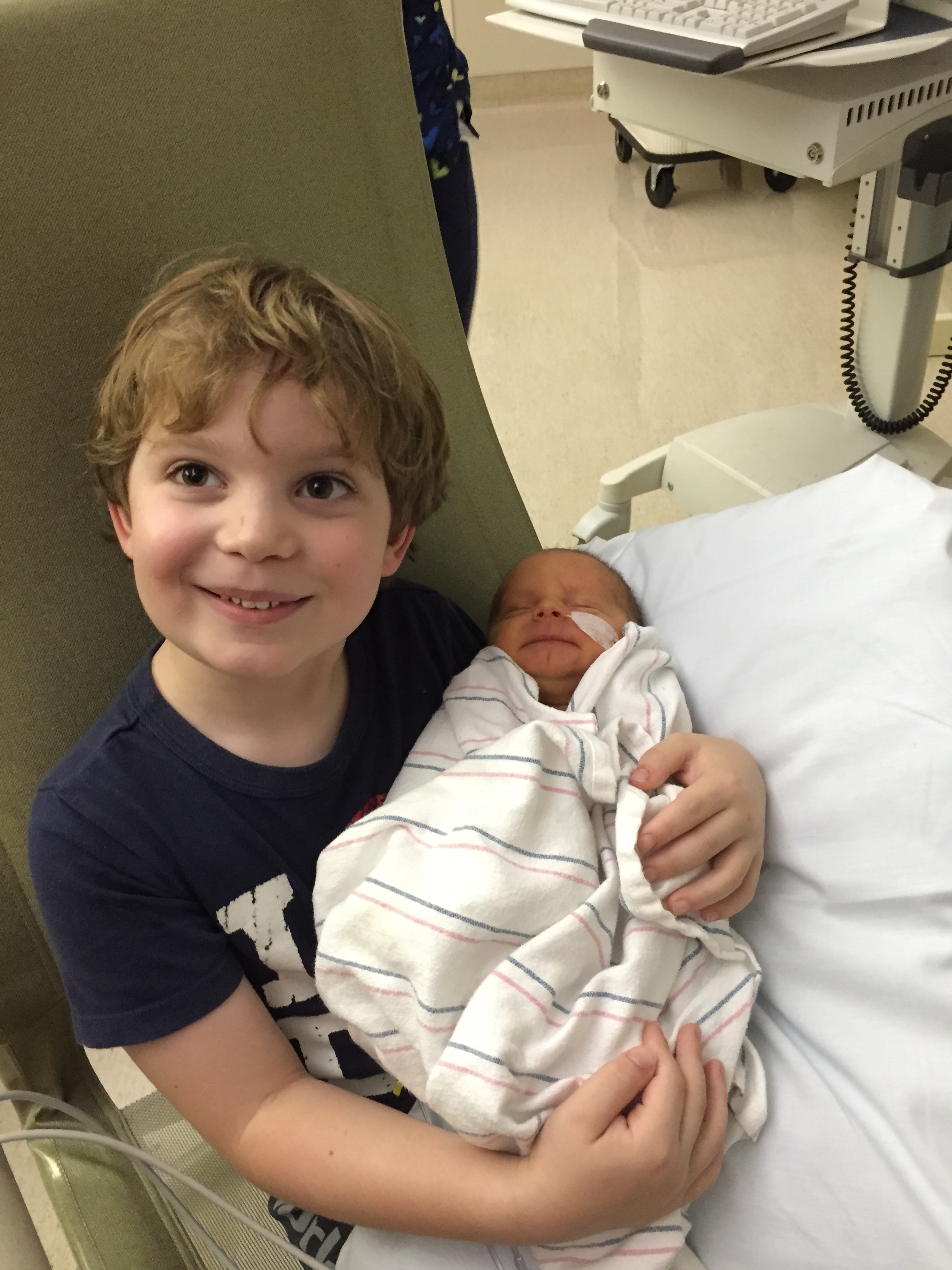
Oh, and Ryder finally got to see him and hold him after that first week in the NICU. Here’s a picture of that. And the joy is still there.

P.S.: Ryder got his donuts, as promised.

Calvin, Pt. 2

I’m trying to rebuild the habit of writing on a regular basis – every day is still a ways off, but I’m hoping at the very least to post on this blog every 1-2 weeks. The ideas aren’t flowing freely out of the tap yet either, so I have to flex the muscle to keep it flexing. But I’m in my chair, the headphones are on, and the soundtrack to Braveheart just started rolling. That’s always been good chill-out writing music for me, ever since college when I first bought the CD. Still works. So here we go.

I thought I’d follow up last week’s post with a little more about Duncan, since coping with his autism is a big part of what this blog is now about. Specifically, I want to go back to Calvin & Hobbes and dig into his love for that again. My therapist asked me last week why I thought Duncan was so drawn to Calvin, and, being the deep thinker that I am, I already had an answer ready to go. I saw similarities in Duncan’s personality and Calvin, and that sent me down a path to an interesting revelation: I think it’s entirely possible that Calvin is autistic.

The parallels are strong: wicked high intellect, trouble staying focused in school. A powerful imagination, a focus on one’s inner life to the exclusion of the world. Difficulty communicating, especially on subjects outside of one’s own interests. I mean, Calvin’s best friend is his stuffed tiger, and the life they live inside his little, expansive head is the stuff of legends. I don’t think for a second that Bill Watterson intended Calvin to be autistic – the strip was written for adults to reminisce in their own childhoods with the knowledge they have as adults. It ain’t really for kids. Plus, Watterson is notoriously private (there’s a documentary about just how reclusive he is), so if that was his intent, we’ll probably never know. But the parallels are fascinating, and these days you can see just about anything in hindsight, thanks to the miracle of post-modernism.

I gave my therapist this answer, and he agreed with me that a case could be made, for sure. I felt like I’d somehow Made A Contribution To The World. I was, for a moment, proud of myself and my own obviously prodigious intellect. And then, right after our session, the therapist sent me a link to a reddit thread about the subject, just to keep me in my place.

So yeah, someone else has noticed it, too. I followed the thread he sent me for a few lines, and the poster had some support, and then someone dropped this comment:

“Or maybe he’s a fucking kid.”

This wasn’t the first comment to disagree and to posit that, most likely, Calvin is just a six-year-old, prone to wildly imaginative play, love of his stuffies, and trouble controlling himself. Absolutely. I even said this about Duncan in my last post: he’s five, but amplified. It’s been an ongoing challenge for us to try to suss out exactly where Duncan’s autism blends in with his age and level of maturity, and it’s damn hard to do. Neurotypical children are often short-tempered, have trouble communicating, especially when upset, and can display a lack of empathy for others. All absolutely true.

But the sneer I read into this comment really lit me up. Again, I don’t pretend that I know what Watterson intended when he created Calvin, I just know I see a reflection of my son in him, and that makes me love both Calvin and Duncan that much more. but there is an implied negativity to this particular comment that I can’t overlook. And you can say that all parents love their children, and of course this is also absolutely true. And (hopefully) no one will deny that raising a child on the spectrum can be extremely challenging – just wait til I tell you about dinner Friday night, or Duncan’s first day back in school – and it is this love, this overwhelming, almost frightening, powerful love, that gives you the strength to get up every morning and keep trying to raise that child, and it gives you a perspective on kids that parents of neurotypical children just don’t have.

And this isn’t a slam on those parents – fuck me, raising ANY decent child these days is a goddamn marathon – but this asshole made it pretty clear in his reddit comment that there was something wrong with assuming Calvin could be autistic. And that pissed me off. And it’s the implied use of the word “normal”. More accurately, Normal. Capital N. Granted, the commenter didn’t say that, and he even qualifies later by saying he’s not trying to be aggressive, but it’s there. Normal.

Don’t get me wrong. I’m still new at this, I’m learning to cope with my son’s outbursts and intractability, I’m learning when to hold boundaries firm and when to let some things slide. I’m still learning to love him because of what his condition could give him, and I’m still hoping that he can have a happy, productive life. And I know it’s gonna take a lot more work to get him to some of those places that it would for a neurotypical kid – a kid like his older brother, for instance – and it’s up to me to help him with that. I’m learning to let go of anger when he does something that I don’t want him to do, how to cope with my own fears and disappointments, and how to appreciate his uniqueness, and how to revel in whatever gifts his condition eventually bestow on him.

I DO know that I won’t be ashamed of him, nor will I hide it or treat it like a disease. I know that I don’t ever expect him to be Normal. Fuck that. Looking at the state of the world, Normal was only working for a few people, so then it really wasn’t that normal, then, was it? I’ve always been drawn to misfits, outcasts, weirdos, iconoclasts – these were the kids I was friends with in school, because I didn’t feel exactly Normal myself, either. I questioned things when a lot of my peers didn’t. I called out absurdities when I saw them, I could see when people were in pain. I was just drawn to people who saw the world differently. Normal has never been a thing for me.

As a parent, some of that changes. There are things that have to happen – toilet training, learning to read, tie your shoes, go to school, cooperate – valid, useful, important skills that everyone in the world needs, and a large number of us don’t seem to have, I might add. So maybe Normal doesn’t mean anything at all, and in fact, what we consider Normal might be the exact opposite of what truly IS normal. So I won’t use that word. And most parents of spectrum kids don’t use that word when referring to neurotypical kids, and I totally get it. I slip up every now and then, but, like so many other labels these days, I’m trying to use better ones. I’ll just call him Duncan, because that’s what he says is his name, and I will protect and defend him from anything or anyone who tries to hurt him.

Is Calvin autistic? Actually, like another guy says in another thread, he’s ink on paper. 100% true. Plenty of people have also said he could be a poster child for any number of disorders. Throw open the DSM-IV manual, close your eyes, and point to a word on the page, and he can probably satisfy some of the criteria for whatever you land on. ADHD, sociopathy, you name it. Armchair psychologize the shit out of that and make yourself happy.

But, Calvin gives me a window of understanding and empathy into my son’s condition, and that, for me, is also absolutely true. I loved Calvin a lot when I read the strips in the paper every day, and I loved him when I bought all the collected strips from the bookstore. I loved him when I gave them to my older son, Ryder, to read and to cackle over. And now I love Calvin even more, because he reminds me of Duncan. And Calvin is most definitely NOT Normal. Thank Christ.

POSTSCRIPT: I have to say that we recently hid the C&H books from Duncan for a while, because among Calvin’s vast and impressive vocabulary are a ton of creative insults, and Duncan became very good very fast at using them on us when he gets upset. Not his fault, it’s mine for not thinking about that when I let him have the books, so it’s on me if he ever calls me or anyone else stupid. I’ll own that, and I’ll try to fix that mistake. But I hope he can read them again someday soon. Because I was enjoying reading them again, too.

POST-POSTSCRIPT: I should also add that for the last three days he has insisted that his new name is “Zombie”. it hasn’t stuck yet, but you never can tell…. Thanks, Parry Gripp.

POST-POST-POSTSCRIPT: My older son, Ryder, the main reason I started this blog almost a decade ago, turns eleven tomorrow. I’ll try to write about him next time. Some of the people that follow this blog must be curious about how he’s doing.

Calvin

My five year old son Duncan loves Calvin and Hobbes. LOVES it. He buries his head in one or more of the several collections we have at the house, every single day. When we go to bed, he has me read several pages of the Sunday color strips to him instead of regular books. He acts strips out, running into the room with a cardboard box on his head and droning, “I am the world’s most powerful computer. Ask me a question”, or using that same box as a time machine with his brother and hunting dinosaurs. We even had a friend make him his own stuffed Hobbes for Christmas (not for sale, we respect Bill Watterson’s anti-commercial stance). Some nights, he goes to bed by himself and reads the strips until he passes out cold, and then I go in and turn off the light. Sometimes he wakes up in the middle of the night and turns the light back on and reads again for hours, which leads to awful mornings, so we keep trying to break this habit. If we don’t, it can throw the next several days off, leading to screaming fits and refusal to go to virtual school. So we try to keep his sleep consistent. 

My son is also autistic. We just found this out in November. We’d suspected there was an issue for a while – his preschool had told us for months that he refused to cooperate in class, that his behavior was a problem. He hadn’t talked until he was almost two and a half; he wouldn’t smile at the camera in family photos unless it was one of us taking them; he didn’t always communicate or listen well. We’d had his hearing tested at around three and a half or so, since he didn’t always seem to listen. In March of last year, as he was getting ready for kindergarten in the fall, we had a psychologist from the school district observe him at preschool to see if he should have a full assessment before school started. It was scheduled for March 31, and then California was locked down on the 19th because of the COVID pandemic. No in-person services were to be provided until everything was deemed safe enough. 

Finally, in November, after months of virtual school (I’ll do a separate post on what school has been like), Duncan got his assessment. And the verdict: high-functioning autism, essentially what used to be known in America as Asperger’s Syndrome. Side note: While the DSM Manual no longer recognizes Asperger’s as its own syndrome and folds it into autism spectrum disorder, the WHO still recognizes it as its own separate disorder. There are reasons this makes sense to me: Asperger kids are usually extremely intelligent and communicative and have a much better long-term prognosis. And Duncan is definitely extremely intelligent. Right before the lockdown happened last March, he literally taught himself to read by streaming Amazon Music on the TV. I mean that: he figured it out all on his own. We weren’t even really trying to get him to read much. He knew the alphabet and early numbers, but it was by istening to heavy metal through the Fire Stick that he figured out words. The first word he read on his own: TOOL. He and I share a love of the band, and I’m eternally proud. He also loves Iron Maiden, AC/DC. Aerosmith, and Meghan Trainor. He’s got eclectic taste.

Lockdown has been mostly good for him. We knew that he hated, HATED, preschool, and he cried most times when we left him there (and of course, for that, there is enormous guilt now). His behavior improved, he became more snuggly, and we all got closer as a family. However, the night wakings could be brutal – there was almost a solid month-long stretch where he and I and Julee never got a full night’s sleep. It was exhausting, and it threatened my sanity more than once. He still had outbursts, and we couldn’t get him to cooperate much, and we were too tired to push it too far. And then virtual kindergarten started.

That was a whole new nightmare. We still hadn’t received his assessment yet, so even though we knew there was an issue, we had no idea what it was, and his lack of reaction when we got upset with him, made us worry about so many possibilities. And while everyone hates online school, Duncan REALLY hates it. He can do the work – in fact, he was the most advanced reader in his class, and he picked up concepts quickly and easily, when he wanted to. We would learn later that this proclivity for focus has to do with “preferred activities” and “non-preferred” ones. You can figure that out, but it’s absolutely true. 

Basically, what Asperger’s, or autism, seems to mean in our particular case is that Duncan is five, and his disorder amplifies his being five. Everything that’s difficult about having a five year old is more difficult. Tantrums are bigger, longer, and fiercer. His struggle to communicate with us is bigger, because when he gets overwhelmed, he just can’t figure out how to tell us what’s wrong or to calm down. And his bullshit detector is SPOT ON. He’s honest, even when he’s lying to us, which is both hysterical and worrying. When he doesn’t like something, he Lets. You. Know. If he wants something, he really, really wants it, and if he doesn’t get it, he goes ballistic. We have extra childproof locks on all the doors because we’re worried he might open one and wander off. 

Except that he doesn’t want to be anywhere but with us, his family. Because he also loves us with a fierceness that is humbling. We are most definitely on his “preferred” list, and even when he yells at us, insults us (using insults he learned from Calvin, which is my fault and I’m trying to remedy), and seems cold, he reminds us as soon as he settles down. His anger forgotten, he grabs a book and snuggles up in my lap and asks me to read, because even though he can do it himself, he still wants that closeness. And so even if I’m still mad, I do my best to let go of it and read to him. 

We’ve got a long way to go to really help Duncan be successful in life. And that’s all I want – for him to be able to live on his own, have a job he enjoys, maybe a relationship, whatever will make him happy and fulfilled. We don’t understand how he works yet, even though we know him better than anyone else. The Latin root of the word autism is “auto”, which I had never really thought about as meaning “self”. Duncan is a world unto himself, and it’s a fascinating, scary, dangerous world that we as his parents have to be brave enough, kind enough, and selfless enough to explore. We need to be like the bold, intrepid Spaceman Spiff, throttle that saucer down, and meet Duncan on his own terms. And that’s the hard part, because we just want to be able to get him to do what he needs to do or we want him to do, but we have to come to him. And it’s exhausting, heartbreaking, and rewarding. 

I love my son with all of my heart. I get frustrated and furious with him, and I lose my temper, but I always try to remember that he’s not doing it on purpose – none of our children are, at five. And I have to learn how to be okay with meeting him on his terms, on his world, because that’s where he lives, and he won’t venture out unless we give him a reason to. So, to get him to come to us, we have to go to him first. 

So I’ll be trying to post on this blog regularly, mainly about Duncan, but also about Ryder, who’s still a big part of this as well, and about whatever else happens to be on my mind. I need to start doing this regularly for myself. It helps to talk about it. And I hope it helps me and everyone else understand a little more about autism, because it doesn’t always look the way you think it does. I’m learning, every day. 

Agonyzer

I’ve been up since 4:30 this morning thanks to the baby, who, thankfully, is NOT awake right now, and as always, once I’m up, I’m up. The wheels start spinning, and all things I normally process while asleep are right at the front of my mind, needing exploration, cogitation, and in some cases, expression. It’s a regular occurrence for most writers, I think, and it often results in some of the best ideas. I used to keep a notebook by the bed in case I woke up from a dream with the greatest idea since beer and had to write it down before I forgot. Writers often sacrifice sleep to satisfy the muse, to exorcise the demon, to agonize over the thoughts that can take you to places too dark to sleep. I woke up this morning because of the baby. I’ve stayed awake because of the death of someone I know.

To say I knew Logan well would be a gross overstatement. We had mutual friends in high school, and we were I the same room together a few times. I knew the people he knew better than I knew him, and vice versa. When we met as adults, he didn’t even remember any of this, but, for some reason, I did. He had stuck in my head at some point, I can’t even really tell you why, but he did. And to say that we became fast friends as adults would also be doing a disservice to those who could truly call themselves his friends. I wouldn’t presume to do so. I’d say that we became peers. Both writers, performers, lovers of strangeness and neither of us entirely comfortable in the world yet coping with it the only way we knew how, by putting it out there, telling stories, trying to reshape the world thru our words. Trying to make some sense of our pain. Logan was a champion of the work I was doing with my theatre company, and I began to follow his fiction career. Both struggling artists, doing our best to say what we had to say. I respected Logan and what he was trying to do with his life. God knows living a creative life isn’t easy. Ever tried. Ever failed. No matter. Try again. Fail again. Fail better. Samuel Beckett said it. Logan would approve.

But sometimes it becomes too much.

Logan and I weren’t that close, I’ve made that point. Yet I’m at an age in life when the deaths of peers affect me. People matter, whether they know it or not, and I grieve Logan’s loss because he should be grieved. His death has affected me, and I’m dealing with it the only way I know how, by writing about it. Again, I’m sure Logan would approve. I knew him well enough to know that words mattered to him, his words mattered to him. He used them to tell stories that mattered to him. He has left an indelible mark on the world by using his words, and I felt the need to honor him for that service. I’ve meant to do it for a while, and it’s too little too late, but I’m buying his book, Ravencroft Springs, on Amazon today, so that his words will have a place on my shelf. And if you would, consider donating to help his wife with necessary expenses. Here’s the link:

https://www.gofundme.com/66wp6aus

I can’t speak as to Logan’s pain. I just didn’t know him well enough. But the title of this post is the name of his own blog, and, as I said, Logan knew what he was doing with words. It’s all there, in that one word. Simple, devastating truth. Beckett would approve.

Rest in peace, Logan.

Postscript: Anyone who reads this blog (admittedly only a few) have realized by now that the birth of my second child has more or less stalled any activity on this account. But he’s three now, and I intend to change that, especially given the state of the world and the country right now and my own feelings about where we’re all at. I intend to devote future posts to diving into those thoughts and feelings, but while reviewing what I haven’t done in years, I came across this entry that I never published. I doubt the GoFundMe link works anymore, and it’s shameful of me to admit that I never posted this, but I’m doing it now, because Logan deserved it.

Back in the Saddle

Write. Every day. Whatever. No matter what. Write. Write every day.

Apparently, once I fall of the wagon, I fall hard. I’ve had numerous ideas for posts in the last couple years, even started banging out early drafts of a few of them, and never got around to finishing them. I’m looking at them just below the box I’m typing in, wondering if any of them are worth finishing at this point, since they’re largely dated. No idea. May go back and give each of ’em a once-over just for the sake of it, and maybe save anything promising.

Write. Every day. Whatever. No matter what. Write. Write every day.

I carry a notebook around with me most of the time so I can jot down thoughts and ideas, nuggets of inspiration and whimsies, and, since most of the time my hands are full of baby these days, the notebook doesn’t get much use. The spine, stiff from lack of stretching, desperately in need of some book yoga to loosen it up, get it feeling like a BOOK again. I used to be really good at scrawling random musings in a notebook. Even had one where I played with the format of HOW I wrote all the time, writing upside-down, solely around the edges of the page, spiraling into the center. The kind of shit you do in your twenties that you think makes you “edgy”.

Write. Every day. Whatever. No matter what. Write. Write every day.

I spend more time writing posts on Facebook, ranting about politics (which I did this very morning) or making amusing comments on the latest Onion article (a venerable, worthy institution, one for whom I would love to write someday if I could only remember how to be that funny). I do, apparently, make several friends’ day with my efforts, so it’s not a total loss. But I’m not really saying anything, not generating any thoughts of my own.

All that’s about to change.

Don’t worry, I’m still gonna post articles from the Onion, because they’re funny as hell and some of the most painfully accurate satire there is these days. Can’t live without that. But I’m losing my own voice, and I can’t have that. So that’s why I’m repeating this little mantra.

Write. Every day. Whatever. No matter what. Write. Write every day.

That’s my challenge to myself. Whatever it is, write it. This blog. Plays. Screenplays. Prose, Poetry. My own brilliant satire, whenever I come up with some. Turn the goddamn TV off and write. Put the kids to bed and write.

Oh yeah, I have two kids now. Pretty much anyone who follows this blog is already aware of that. One’s asleep in his crib right now, and the other is outside playing with his dart guns, so I’m stealing a few minutes to get to it and write. I love my boys so much it hurts, but they’re a lot of work, and it makes it hard to do the other work that matters to me, too. But

I’ve always tended to be pretty stream-of-consciousness when I write; too much structure up front stifles me, and if I know exactly were I’m going at the end, I often lose interest in getting there. But, I live in Los Angeles now, and scripts need to be tight, well thought out, and usually of a certain length. I ain’t too old to learn new tricks. So, my professional work is gonna be tightly plotted (with room for improvisation and inspiration), and the other stuff – like this blog – is gonna wander.

But I’m still gonna talk about the things that inspired this whole blog-like thing: I’m a dad, I’m a men, I’m a lot of things, and I’m gonna continue to explore them and write about them. Fatherhood, manhood, guns, movies, fart jokes, books, Star Wars, sex, comedians, politics (once in a while, if I can keep the vitriol down). Anything and everything. and beer. DEFINITELY beer. I’m turning this blog into my little notebook that I thought was so cool. And, I’m gonna start writing in that notebook again, when my hands aren’t full of baby. Damn, he’s big.

I ALSO wanna take a moment to recognize all the new fathers I know from the past year. Whatever was in the water, we all drank it, and DAMN, there are some amazing new creatures in the world because of all of us gettin’ naughty. Congrats to Eric, Dan, Kahlil, Colin, Jonathan, Joey Bag-o-Donuts. I know there’s more, and I apologize for not being able to remember your names right now, but , as you all know, baby brain ain’t just for women anymore. Welcome to the brave new world of raising a responsible human being. You’re about to earn your grey hairs.

I ALSO wanna open up this forum to all the dads I know, new and old, and invite you post your own musings on manhood with me on this page. Basically, let’s start talking about it together. I’m happy to moderate, if anyone’s interested. If not, I feel ya, I’m tired all the time, too. But I’d love to hear from you. No rules on content, format, whatever – you wanna write a play about being a dad, bring it. I’ll post it. Whatever’s on your mind. If you’re so inclined, this is a place to let it all rip. I’m sure you’ve got something to say, so let me know if you want to say it here.

Write. Every day. Whatever. No matter what. Write. Write every day.

If we keep it up, sooner or later we’ll write something worth reading.


P.S.: Next time, I’ll write about my new baby boy. Stay tuned….